
The Shiny Object Syndrome Has Never Been This Expensive
The AI industry has an $800 billion gap between what it spends and what it earns. Every week, thousands of founders are building products that ignore it entirely, because the demo is impressive and the LinkedIn posts are going viral.
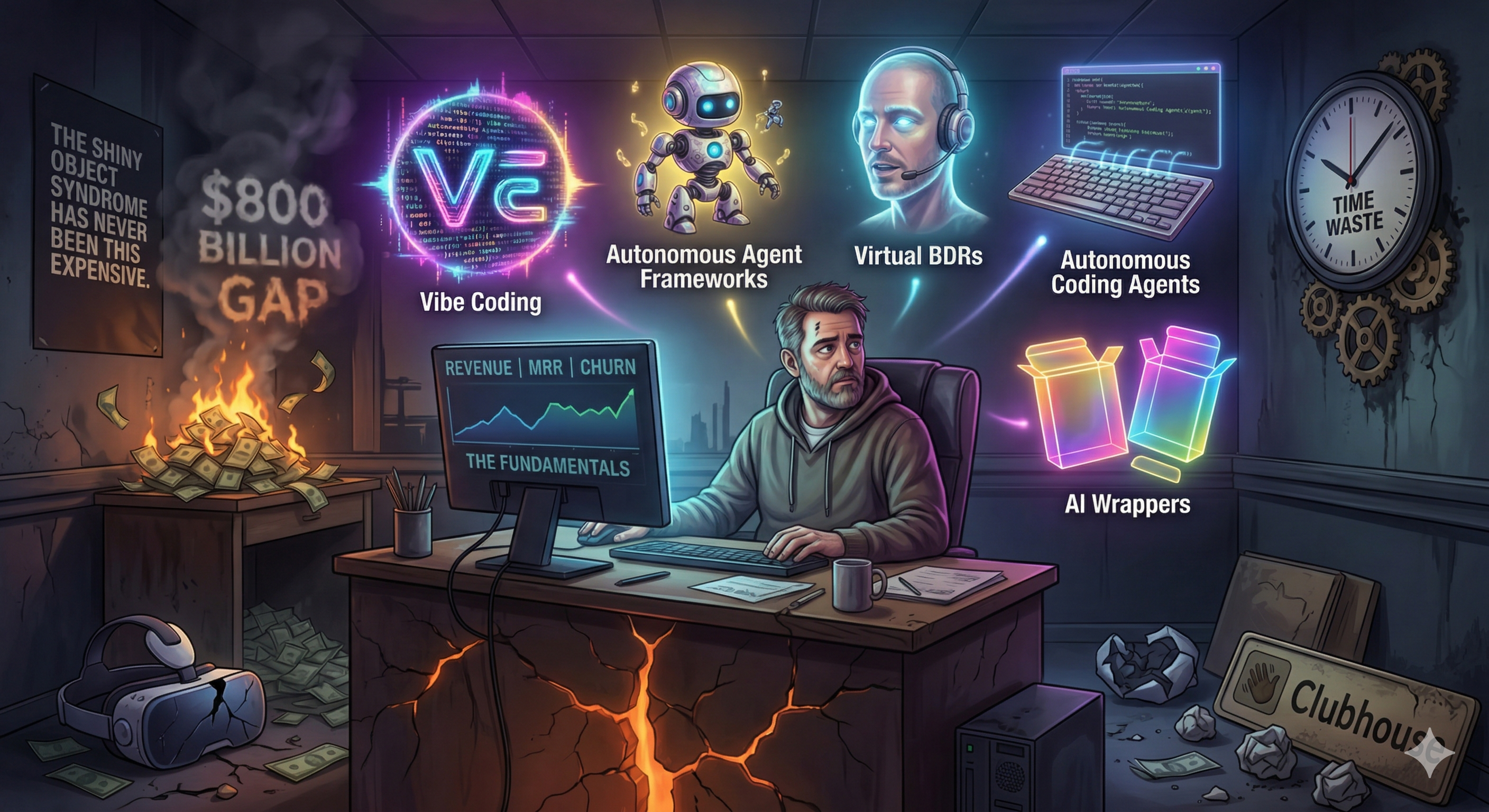
The Shiny Object Syndrome Has Never Been This Expensive
The AI industry has an $800 billion gap between what it spends and what it earns. To justify current infrastructure spending, AI needs $2 trillion in annual revenue by decade's end. Best-case forecasts say $1.2 trillion. That gap isn't a rounding error. It's a structural problem.
And yet, every week, thousands of founders are building products that ignore it entirely, because the demo is impressive, the GitHub stars are climbing, and the LinkedIn posts are going viral.
I've Watched This Movie Before
I've been mentoring startups for over ten years at TechStars and Google Startups. In that time I've watched five technology hype cycles follow the exact same arc: a genuinely interesting technology emerges, capital floods in, demos go viral, founders mistake engagement for validation, and then fundamental business reality arrives like a bill nobody budgeted for.
Web3 was going to decentralize everything. It decentralized nothing of commercial consequence. The Metaverse was going to replace the office. Meta spent over $40 billion building virtual rooms that stayed empty. Clubhouse was the future of human communication. It peaked in ninety days. Google Glass was going to change how we see the world. It changed how we see people who wear technology on their face in public.
But here is where the lesson gets more instructive than a simple failure list. Meta didn't disappear after the Metaverse collapsed. They diagnosed what went wrong and rebuilt around a different assumption.
The Metaverse failed because it asked people to leave reality. The Ray-Ban Meta glasses succeed because they stay in it. They look like glasses. They feel like glasses. They add a thin, useful layer of AI without interrupting your life. In 2025, Meta sold over 7 million pairs. Revenue more than tripled. In 60% of Ray-Ban stores across Europe, they are the number one best-seller.
Same company. Same category. Opposite outcomes. The difference was not the technology. The difference was whether the product respected or ignored fundamental human psychology.
Technology doesn't fail because it isn't impressive enough. It fails because it doesn't solve a problem someone will pay for, month after month.
The Five Shiny Objects of 2026
01. Vibe Coding: Right Tool. Wrong Use Case.
Andrej Karpathy coined the term for throwaway weekend projects. He explicitly said so. The tech world ran with it anyway. By 2025, 25% of Y Combinator's Winter cohort had codebases 95% AI-generated, funded startups with real users in production. In March 2026, Amazon's vibe-coded deployment caused a six-hour outage and an estimated 6.3 million lost orders. Sixteen of eighteen CTOs surveyed reported vibe coding disasters in production systems.
The tool is real. The use case being sold is not. Vibe coding is a legitimate accelerant for experienced engineers building prototypes. It is not a production strategy. It is not a company.
95% of AI pilots fail to produce measurable revenue (MIT 2025 · Amazon outage: 6.3M lost orders) March 2026
02. Autonomous Agent Frameworks: Great Vision. Wrong Decade.
If you've read Max Tegmark's Life 3.0, you understand the long-term vision. It is compelling and probably correct. It is not where we are in 2026. Founders are building AI CEOs that delegate to AI COOs that manage AI SDRs, organizational hierarchies borrowed from century-old human management theory, applied to systems that have none of the cognitive constraints those structures were designed to manage.
Gartner predicts over 40% of agentic AI projects will be canceled by 2027. Ninety percent of legacy agents fail within weeks of enterprise deployment. The "Year of the Agent" has been declared for two consecutive years running. The vision is real. The timeline being sold is not.
40%+ of agentic AI projects canceled by 2027, Gartner · 90% of legacy agents fail within weeks
03. Virtual BDRs: Wrong Diagnosis. Dangerous Prescription.
Remember Total Recall? Nothing is quite what it seems (including who is actually selling to you. Virtual BDR startups made a diagnostic error at the foundational level. They looked at B2B sales and concluded: the human is the bottleneck) remove them. Wrong diagnosis. Catastrophic prescription.
In B2B sales, the human is not the bottleneck. The human is the product. Buyers aren't purchasing a service. They are purchasing trust. No LLM replicates that. No autonomous agent earns it. The real bottleneck was never the human, it was the time humans waste on research and delayed responses. Remove the waste. Keep the human. People buy from people. Ten thousand years of commerce says so.
Bain Capital Ventures 2026: "AI can't start a relationship, read a moment, or build trust with a prospect"
04. Autonomous Coding Agents: The Model Writes the Code. It Has No Idea What Your Business Needs.
This is the most uncomfortable shiny object on this list, because the companies building it are the most sophisticated AI labs in the world. The models are not stupid. They are context-blind.
An autonomous coding agent can write a feature in minutes. What it cannot know (unless explicitly provided) is that the application needs Row Level Security, complies with GDPR, follows Australian privacy law, or serves the specific edge cases your customer discovery revealed. The model does not ask. It assumes. It ships. One healthcare company's experience: six weeks to write the code, nine months of legal and compliance review before it could be deployed.
If an agent achieves 85% accuracy per step, a ten-step workflow succeeds only 20% of the time. Without a validated market vision, real customer discovery, and a compliance framework the agent has never heard of, it doesn't build a product. It builds a very convincing prototype of one. The next generation of wrappers, shipped faster.
85% per-step accuracy = 20% success over 10 steps · 73% deploy AI coding tools, 7% govern them (Cybersecurity Insiders 2026 · AI code has security vulnerabilities at 1.5-2x human rate) Stack Overflow 2026
05. AI Wrappers: Features Dressed as Businesses.
The largest and most consequential category. Between 2023 and 2025, an entire economy emerged of startups built on one architecture: take an API call, add a UI and a prompt, charge a subscription, call it a company. The test is simple: if the foundation model provider shut down your API key tomorrow, does your startup survive? For most, the answer is no. The model is the product. The wrapper is the packaging.
14,000 AI startups launched in 2024. 40% have already closed. Wrapper margins run at 25% versus the 70-80% of defensible SaaS. Builder.ai (Microsoft-backed, valued at $1.2 billion) filed for bankruptcy in 2025. Every model update renders entire wrapper categories obsolete overnight.
14,000 launched in 2024, 40% already closed (SimpleClosure 2025 · Builder.ai: $1.2B → bankruptcy · Wrapper margins ~25% vs 70-80% SaaS) Bessemer
The Three Real Business Problems Nobody Is Solving
| Metric | Data | Source | |--------|------|--------| | 9x Higher B2B conversion | 5 min vs 24hr response | HBR | | 60% of sales rep time | Spent on admin, not selling | Salesforce | | $800B gap | Between AI capex and projected revenue | Bain estimates |
Speed to Lead
Responding to a B2B lead within five minutes versus twenty-four hours increases conversion by nine times. The average sales team responds in two days. The right AI intervention removes the friction and keeps the human. Speed without removing trust.
MRR Growth and Churn
The only two numbers that tell the honest story of a business. Everything else (GitHub stars, agent count, automation percentage) is a vanity metric. A business exists when customers pay for it month after month because it solves a problem they cannot easily solve without it.
Trust at Scale
The hardest problem in B2B growth is maintaining genuine human trust as you scale. Every company that has tried to solve this through automation alone has discovered the same truth: buyers notice. Not because the AI is bad, but because trust is not a function of message quality. It is a function of human presence and accountability.
What Good Actually Looks Like
The companies that will define this decade are not the ones with the most sophisticated agent architectures. They are the ones that identified a specific, painful, expensive problem (one that existed before AI) and built AI into the solution in a way that makes the outcome faster, more reliable, and more defensible over time.
The survivors will have proprietary data or workflow advantages that no model update can replicate overnight. They will be measurable in the currency their customers care about. They will have human judgment embedded in the loop at the moments that matter.
The question worth asking is not "what's the most impressive AI technology available?" It is "what problem do my customers wake up at 3am worrying about, and how does this make it go away?"
The shiny objects have never been shinier. The fundamentals have never mattered more.
What did you actually ship this week?
FAQ
What is Shiny Object Syndrome in AI? Shiny Object Syndrome is when founders and companies chase the latest impressive AI technology (vibe coding, autonomous agents, virtual BDRs) without validating whether it solves a real business problem that customers will pay for month after month.
Why do most AI startups fail? Most AI startups fail because they are built as thin wrappers on foundation model APIs with no proprietary data, workflow advantage, or defensible moat. 40% of the 14,000 AI startups launched in 2024 have already closed.
What should AI founders focus on instead? Focus on speed to lead, MRR growth and churn, and trust at scale. Identify a specific, painful, expensive problem that existed before AI, and build AI into the solution in a way that keeps human judgment in the loop at the moments that matter.
Frequently Asked Questions
What is Shiny Object Syndrome in AI?
Shiny Object Syndrome is when founders and companies chase the latest impressive AI technology (vibe coding, autonomous agents, virtual BDRs) without validating whether it solves a real business problem that customers will pay for month after month.
Why do most AI startups fail?
Most AI startups fail because they are built as thin wrappers on foundation model APIs with no proprietary data, workflow advantage, or defensible moat. 40% of the 14,000 AI startups launched in 2024 have already closed.
What should AI founders focus on instead?
Focus on speed to lead, MRR growth and churn, and trust at scale. Identify a specific, painful, expensive problem that existed before AI, and build AI into the solution in a way that keeps human judgment in the loop at the moments that matter.